Tanium Risk and Compliance: How to Actually Close the Loop

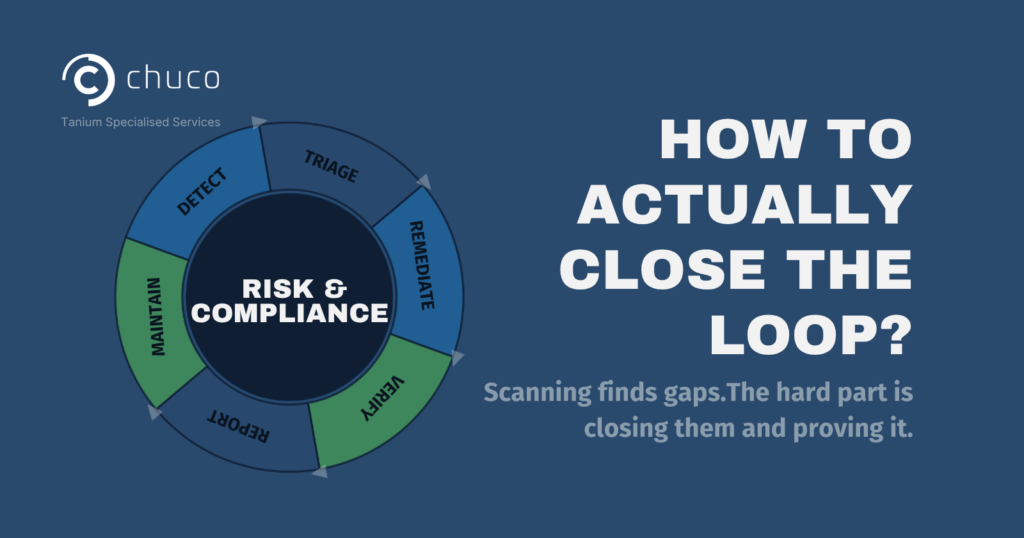
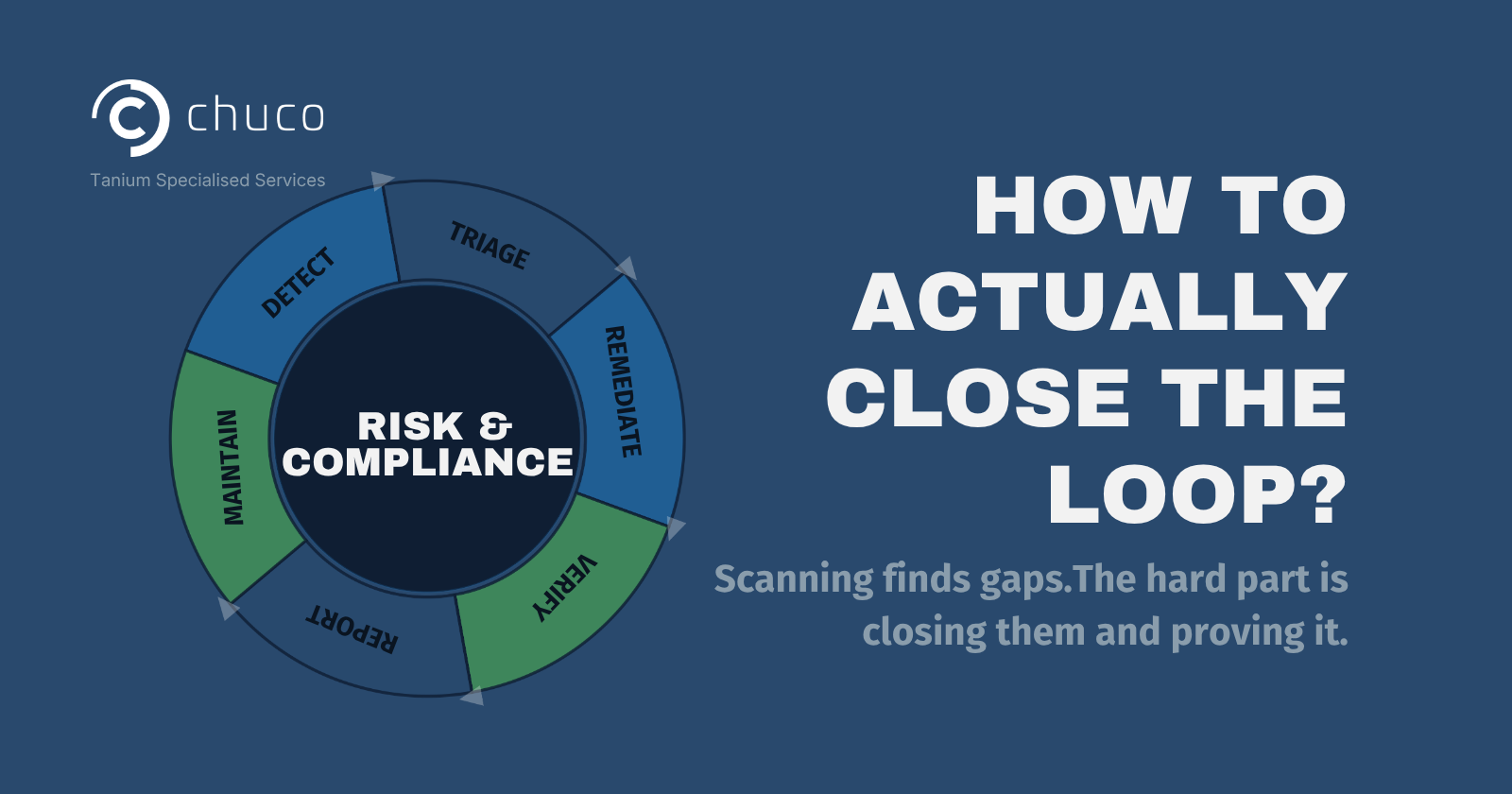
Scanning for compliance gaps is something most organizations already do. The challenge with Tanium risk and compliance isn’t detection. It’s what happens after detection. Triage, prioritization, remediation, verification, exception handling, and reporting. Repeated continuously, across thousands of endpoints, without the backlog growing faster than the team can close it. 

This post covers how the Tanium risk and compliance modules work together to close that loop, where most programs stall, and what good looks like operationally. 

The Detection Side: Tanium Comply

Tanium Comply handles two distinct jobs. Vulnerability scanning identifies known CVEs across your endpoint fleet. Configuration Ccompliance scanning checks endpoints against benchmarks like CIS, DISA STIGs, or custom internal standards. 

Both run in real-time. No agents timing out. No scan results sitting in a queue for days. When a new critical CVE drops, Comply can assess your exposure across the entire environment in the same session. 

The data Comply produces is valuable. The question is what your team does with it in the next 24, 48, and 72 hours. That’s where most programs lose velocity. 

The Remediation Side: Tanium Enforce

Tanium Enforce maintains the desired configuration state across endpoints. Firewall rules, registry settings, security policies, encryption standards. When an endpoint drifts, Enforce corrects it automatically. 

This is the module that turns Tanium risk and compliance from a reporting function into a remediation function. Without Enforce, the workflow looks like this: Comply scans, finds gaps, team remediates manually, next scan finds some of the same gaps again because configurations drifted back. The backlog grows. The same findings appear cycle after cycle. 

With Enforce, the configurations Comply checks for are actively maintained. Findings go down and stay down. The team focuses on new exposure rather than re-remediating old drift. 

Where Patching Fits Into Tanium Risk and Compliance

Not every compliance finding resolves through configuration changes. Many require patches. 

When Comply surfaces a vulnerability that resolves through a patch, the remediation path leads to Tanium Patch for OS updates or Tanium Deploy for third-party applications. The value of a unified platform is that the finding, the remediation plan, and the deployment all live in the same environment. No exporting a CSV from one tool to import into another. No reconciling scan dates with patch dates across separate dashboards. 

This is where Tanium risk and compliance connects directly to patching operations. The two workflows feed each other: compliance scanning identifies what needs to be fixed, patching operations address it through OS patching and third-party software updates, and the next compliance scan confirms the fix took. 

Prioritization: Not Every Finding Is Equal

A critical CVE on an internet-facing server is a fundamentally different risk than the same CVE on an air-gapped workstation in a testing lab. Effective Tanium risk and compliance programs triage findings against the actual risk they represent in your specific environment, not just their CVSS score. 

This means understanding which endpoints are most exposed, which business systems they support, and what compensating controls exist. A scan result that says “500 critical findings” is data. A triage that says “12 of these are on internet-facing production servers with no compensating controls, and those need to be patched by Friday” is actionable intelligence. 

The tooling supports this. The bandwidth to do it consistently is what most teams struggle with. 

Verification: The Step That Gets Skipped

After remediation, verification confirms the fix actually took across every affected endpoint. This is the step that gets skipped most often when teams are stretched. And it’s the step auditors and adversaries both notice. 

Tanium makes verification straightforward. Run the Comply scan again. Compare results. Confirm the finding is closed. The platform can do this automatically. The operational discipline to make it happen every time is the harder part. 

Exception Management: What You Can't Fix Yet

Not every finding can be remediated immediately. A vendor patch that doesn’t exist yet. A configuration change that conflicts with a business-critical application. A legacy system that can’t be updated without a migration plan. 

Mature Tanium risk and compliance programs document exceptions, implement compensating controls where possible, and track open exceptions until resolution. The alternative is a growing list of known vulnerabilities that nobody is actively managing, which is precisely what audits are designed to find. 

Anomalous Software. You can define which software is approved and report on applications that are installed but shouldn’t be present, giving IT and security teams a way to spot unauthorized or unexpected software across the environment.

For CFOs and procurement teams, this is where Tanium endpoint management delivers direct cost savings. Every unused license identified and reclaimed is budget recovered without cutting capability.

What Good Tanium Risk and Compliance Looks Like

Vulnerability counts that decrease in size and severity with each scan cycle, not because findings are being suppressed but because remediation is happening consistently. Configuration drift that gets corrected automatically through Enforce rather than requiring manual intervention. Patch-driven findings that flow directly into patching workflows without manual handoffs between tools. And reporting that reaches the right audience without someone spending hours building it. 

If your compliance program runs on a separate cadence from your patching program, or if the same findings keep reappearing cycle after cycle, the gap is usually between the tools and the operational discipline connecting them. That’s where Chuco, Tanium specialist, makes the difference. 

Getting Started

Want to see how your compliance posture stacks up? Schedule a Health Check and get a clear picture of your Tanium risk and compliance maturity. 45 minutes, no commitment. 

Evaluating Tanium? Request a demo and see the Comply and Enforce pairing in action. Visit our Licensing hub for Chuco Assist, Co-Manage, and Managed AEM options. 

Stay Ahead with the Tanium Insider Newsletter!

Other Resources that might interest you ​