How Managed Services Improve Vulnerability and Remediation
Most organizations can detect vulnerabilities. The hard part is remediating them at scale before they become exposure. Here’s how managed services close that gap.
How Managed Services Improve Vulnerability and Remediation
Chuco managed services for vulnerability remediation address a gap that most security teams know exists but struggle to close: the distance between detecting a vulnerability and fixing it across every affected endpoint.
Detection is the easier part. Tanium Comply can scan your entire environment and return vulnerability data in real-time, no agents timing out, no stale scan results sitting in a queue for days. The Tanium Console gives you a centralized view of what’s exposed and where.
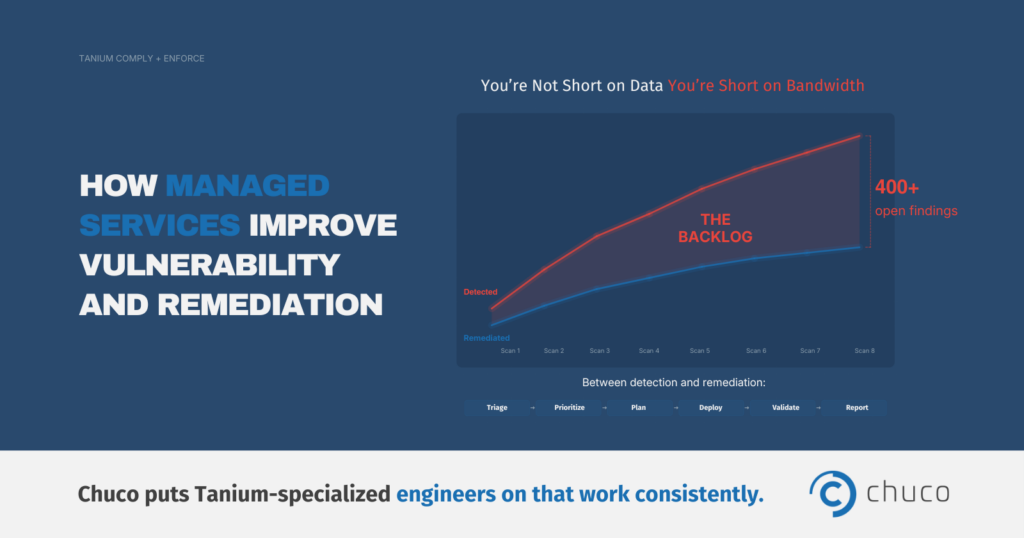
But knowing what’s vulnerable and making it not vulnerable are separated by a lot of operational work. Prioritization, remediation planning, testing, deployment, validation, exception handling, and reporting, all of it repeated continuously as new vulnerabilities emerge. That’s where Tanium managed services for vulnerability remediation make the difference.
Most organizations aren’t short on vulnerability data. They’re short on the operational capacity to act on it fast enough.
A typical environment running Tanium Comply might surface hundreds of new findings per scan cycle. Each one needs to be evaluated against the actual risk it represents in your specific environment, not just its CVSS score. A critical CVE on an internet-facing server is a different conversation than the same CVE on an air-gapped workstation.
Then comes the remediation work. Some vulnerabilities resolve through patching, which means coordinating with your Tanium Patch and Deploy workflows. Others require configuration changes, registry edits, or custom scripts deployed through Tanium. Some require compensating controls until a patch is available.
Without consistent operational support, this work piles up. Remediation SLAs slip. The backlog grows. And the vulnerabilities that actually matter get buried under the ones that don’t.
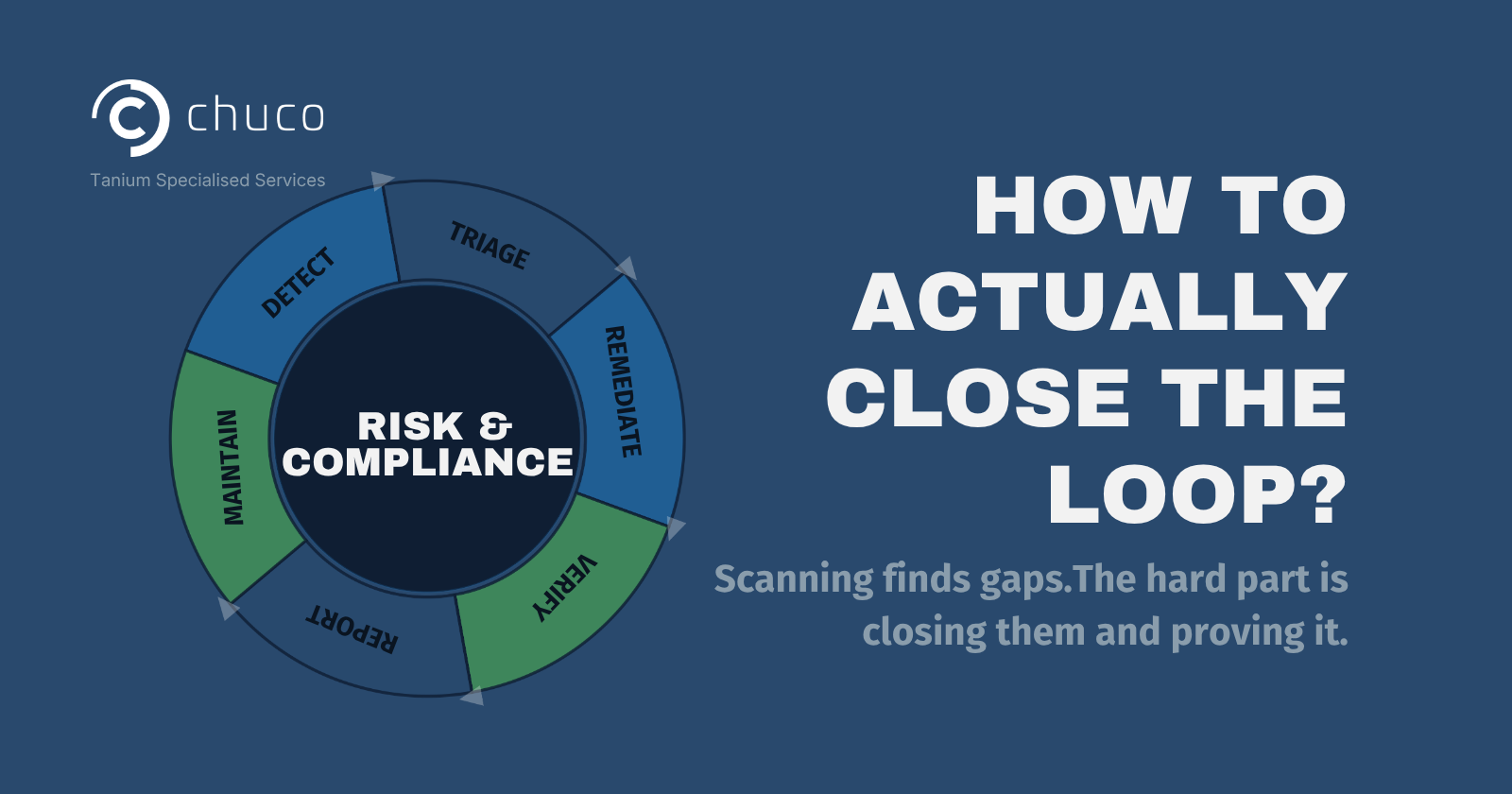
Managed vulnerability remediation goes beyond running scans and generating reports. It means having experienced engineers consistently working your environment to close findings and keep them closed.
We run and manage your Tanium Comply scans on a defined cadence. More importantly, we triage the results, separating critical exposure from background noise based on your environment’s actual risk profile, not just generic severity ratings.
For each prioritized finding, we determine the right remediation path: patch deployment, configuration change, custom script, or compensating control. We coordinate with your patching workflows and change management processes to execute without disruption.
After remediation, we verify that the fix took across all affected endpoints. This is the step that gets skipped most often when teams are stretched and it’s the step that auditors and adversaries notice.
Not every vulnerability can be remediated immediately. Some require vendor patches that don’t exist yet. Others conflict with business-critical applications. We document exceptions, implement compensating controls where possible, and track them until resolution.
We deliver reporting that maps remediation progress to your compliance frameworks, whether that’s internal SLAs, CIS benchmarks, or regulatory requirements. Reports are tailored to audience: executive summary for leadership, detailed findings for technical teams.
Every remediation cycle generates insight. Which vulnerability classes recur most often? Which endpoint groups consistently fall behind? Where do process bottlenecks slow response times? We use this data to refine your vulnerability management posture over time.
The difference between a self-managed vulnerability program and a managed one isn’t capability, it’s velocity and consistency.
When vulnerability remediation is someone’s full-time focus, response times compress. The time between scan and triage shrinks. Remediation plans get built faster. Validation happens consistently, not when someone remembers. And the backlog that most teams carry as a fact of life starts to actually decrease.
This is especially true for organizations running Tanium at scale. With tens of thousands of endpoints across multiple operating systems, the operational surface area for vulnerability management is enormous. Managed services provide the sustained bandwidth to cover that surface without burning out your internal team.
Just like with patching, the right level of managed support depends on how much operational ownership you want to retain.
We set up your Comply environment and vulnerability workflows. Your team runs ongoing operations with access to our engineers for guidance and escalation.
We own the full vulnerability remediation lifecycle. Scan-to-resolution SLAs are our responsibility. Your team focuses on security strategy and risk decisions.
If your vulnerability backlog is growing faster than your team can close it, the issue probably isn’t your tooling; it’s operational capacity.
Our Tanium Healthcheck gives you a clear picture of where your vulnerability management stands today. Our Risk Assessment maps that to actual exposure.
Or if you’d like to talk through what Tanium managed services for vulnerability remediation would look like for your environment, reach out to our team.

Most organizations can detect vulnerabilities. The hard part is remediating them at scale before they become exposure. Here’s how managed services close that gap.

Your team has the skills — what they don’t always have is the bandwidth, Tanium-specific depth, and capacity to deliver consistent results at scale. Here’s how Chuco’s managed services for Tanium patching close that gap.

You can’t secure what you can’t see — but what happens when the tools providing that visibility are the ones failing? We took that question to Tanium Atlas.