How Chuco Works: What to Expect at Every Stage

Most of the content on our blog covers what Chuco does. This post covers how it happens. The actual process of working with us, from the first conversation through an ongoing partnership. 

No mystery. No long procurement cycle before you know what you’re getting. Every Chuco engagement follows a straightforward path, and understanding it upfront makes the decision easier. 

It Starts with a Conversation

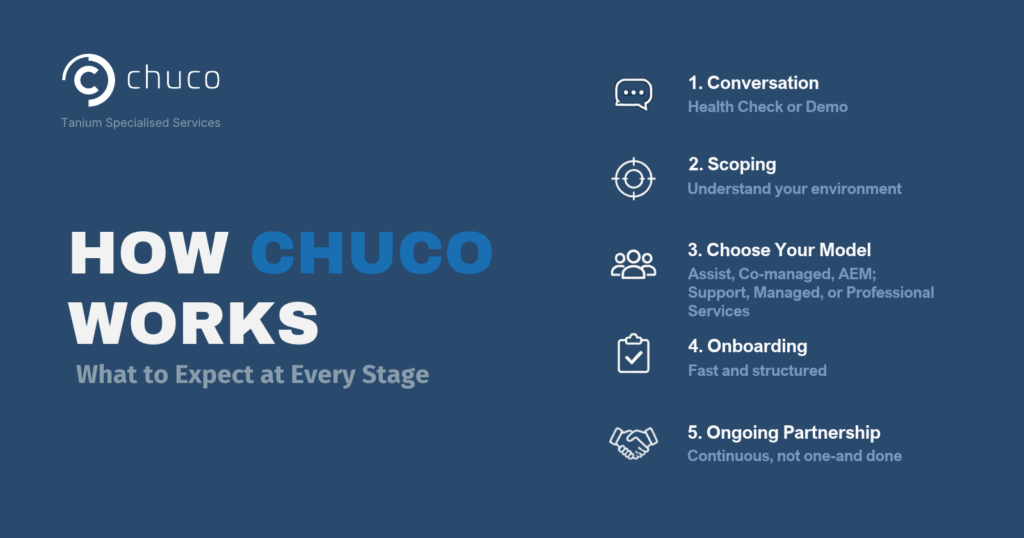
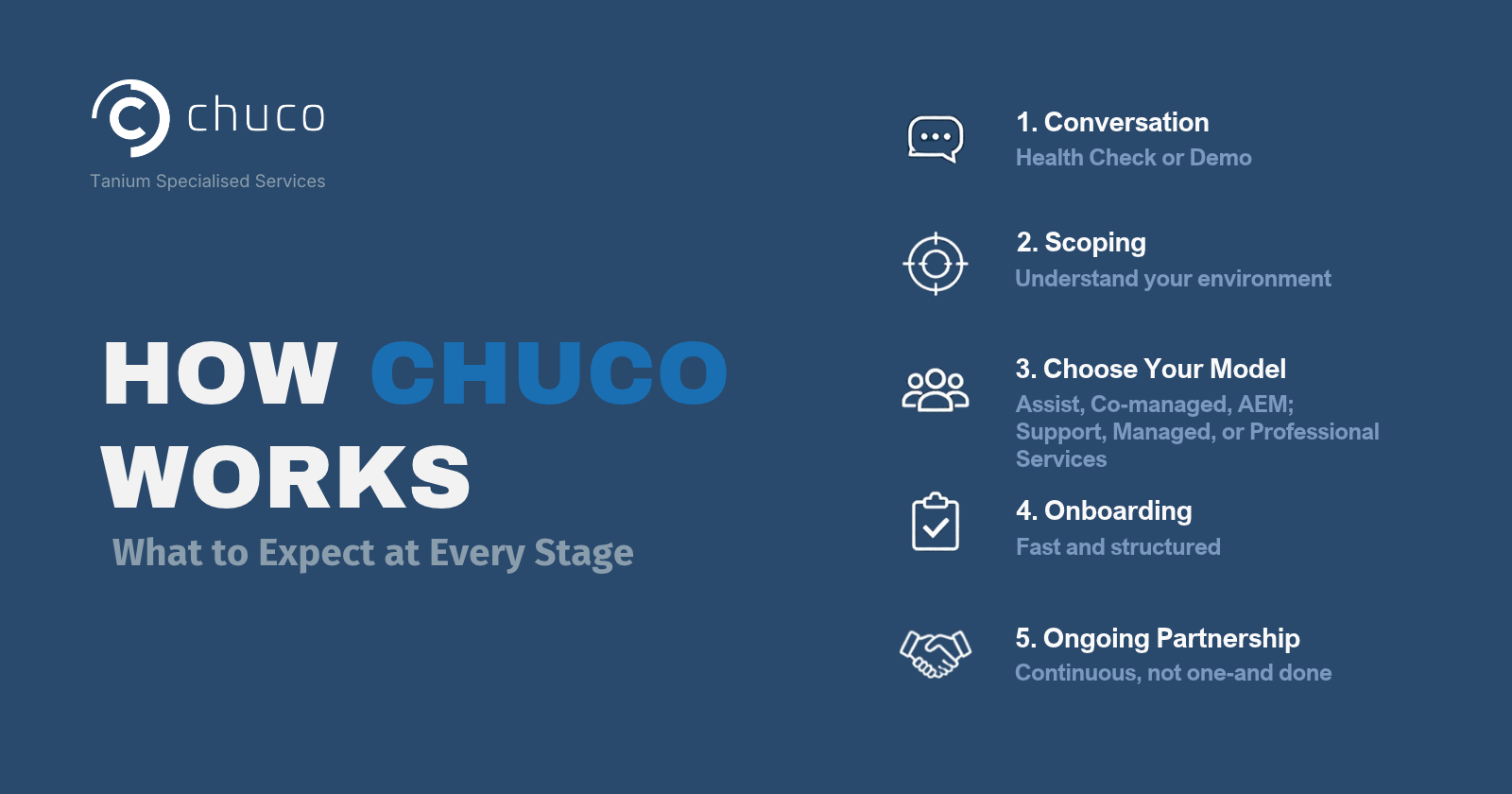
Every engagement begins the same way: a conversation about where you are and what you need. 

If you already own Tanium, the most common starting point is a Tanium Health Check. It’s a focused, 45-minute session with our team where we review how your environment actually performs against what the platform can deliver. We look at endpoint health, patch efficacy, module utilization, compliance posture, and reporting maturity. The output is a prioritized list of findings with specific recommendations. No commitment beyond the conversation. 

Alternatively, if you have a specific challenge in mind, a service consultation takes about 30 minutes. You walk us through the situation, we ask questions, and by the end of the call both sides know whether there’s a fit and roughly what the engagement would look like. 

If you’re evaluating Tanium for the first time, the conversation starts with a demo. We walk through the platform, answer questions about how it fits your environment, and talk through the licensing and deployment options that make sense for your organization. 

In every case, the first step is a real conversation with a Tanium specialist, not a sales pitch from someone reading a script. 

We Listen Before We Scope

After that initial conversation, Chuco takes time to understand your environment before proposing anything. This matters because Tanium engagements vary significantly depending on what you’re working with. 

  • How large is your endpoint fleet? A 2,000-endpoint environment and a 50,000-endpoint environment need fundamentally different approaches to patching, compliance, and reporting. 
  • What does your team look like? Some organizations have dedicated Tanium administrators with years of platform experience. Others have a small IT team managing Tanium alongside a dozen other tools. The engagement model we recommend depends on the bandwidth and Tanium-specific depth your team already has, not on what costs the most. 
  • What’s the immediate priority? Sometimes the answer is a specific project: deploy Tanium for the first time, migrate an OS, fix a broken patching regime. Sometimes the answer is broader: we need someone to run the platform consistently because our team can’t dedicate the hours. The scope follows the need. 

We don’t propose before we understand. The scoping conversation is where Chuco earns the trust that makes the rest of the engagement work. 

You Choose the Engagement Model

Once the scope is clear, you choose how deeply Chuco gets involved. There’s no one-size-fits-all recommendation. The right model depends on your team, your budget, and how much operational ownership you want to retain. 

For organizations already running Tanium: 

  • Support Partnership puts experienced Tanium engineers in your corner when you need them. Staff augmentation, support subscriptions from 10 to 80 hours per month, or a retainer for on-demand access. Your team keeps full control. Chuco fills the gaps. 
  • Managed Services shift some or all of the daily Tanium operations to our team. Partially managed or fully managed. In a full engagement, Chuco handles patching, vulnerability remediation, compliance monitoring, reporting, and environment tuning as a dedicated ongoing function. Your team focuses on higher-priority work. 
  • Professional Services tackle a defined project with a clear start and end. Custom reporting through the Tanium API, complex patching configurations, module optimization. The engagement finishes when the problem is solved. 

For organizations deploying Tanium for the first time: 

  • Chuco Assist covers licensing, deployment, and enablement. Your team takes over day-to-day operations after go-live, with optional enablement packs for training and health checks. 
  • Chuco Co-Manage means Chuco builds and runs your core operational playbooks while you retain change control and handle exceptions. SLAs define what “good” looks like. 
  • Chuco Managed AEM is the full outcome-based model. Chuco runs everything. Operational outcomes become our SLA. Terms run 12 to 36 months. 

The choice is yours. Chuco presents the options with a clear recommendation, and you pick the one that fits. 

Onboarding Is Fast and Structured

Once the model is chosen, onboarding follows a structured process. Chuco doesn’t show up and figure it out as we go. Every engagement type has a defined onboarding path. 

For managed services and support, onboarding typically includes environment access, a baseline review of module configurations, documentation of existing workflows and maintenance windows, and alignment on communication cadence and escalation paths. Most engagements are operational within the first two weeks. 

For deployments, Chuco follows Tanium’s packaging structure: Core, Endpoint Management, Risk and Compliance, and Incident Response. We define the deployment plan, configure the modules, validate the rollout, and hand off a working environment with documentation your team can use going forward. 

For professional services, we define the project scope, milestones, and deliverables upfront. You know exactly what you’re getting and when. 

The Ongoing Relationship

This is where Chuco’s model differs from a typical consulting engagement. We don’t finish a project and disappear. For managed services and support customers, the relationship is continuous. Chuco engineers are consistently engaged with your environment, tuning configurations, responding to issues, and adapting as the platform evolves. 

Tanium ships updates regularly. New modules, changed defaults, new capabilities. Chuco stays on top of those changes so your team doesn’t have to track every release note. When something matters for your environment, we flag it and handle it. 

For customers on support retainers or subscription plans, the relationship scales up and down as needed. Some months you use every hour. Some months things run smoothly and you barely need us. The flexibility is built into the model. 

Health checks aren’t just a starting point. They’re recurring. We recommend running one periodically to catch drift, surface new optimization opportunities, and make sure the platform keeps pace with how your environment evolves. 

What Working with Chuco Feels Like

If the process above sounds straightforward, that’s intentional. We’ve designed it to remove friction, not add it. 

  1. You talk to Tanium specialists from the first call. Not account managers who hand you off to engineers later. The people scoping the engagement are the same people who understand the platform. 
  2. Recommendations come with reasoning. When Chuco suggests an approach, you hear why. The alternatives, the trade-offs, and what each option means for your team’s workload and your budget. 
  3. Communication stays consistent. Regular check-ins, clear escalation paths, and a team that knows your environment because they work in it every day. Not a rotating cast of consultants reading last week’s notes for the first time. 

The goal is always the same: make Tanium deliver what you bought it for. 

Getting Started

Already using Tanium? Schedule a Health Check. 45 minutes, no commitment. See where things stand and what to prioritize. 

Evaluating Tanium? Request a demo and see the platform in action. 

Have a specific challenge? Book a service consultation. 30 minutes. Walk us through it, and we’ll tell you what we think. 

Or browse our Services hub and Licensing hub to explore the options on your own time. 

Stay Ahead with the Tanium Insider Newsletter!

Other Resources that might interest you ​